


The RBNZ kept interest rates on hold at 2.25% as expected in their February policy statement while updating economic forecasts to signal that they are in no rush to tighten.
Which NZD strategies moved beyond the watchlist stage, and how did the “dovish hold” announcement translate to price action amid some risk-off flows spurred by geopolitical tensions and U.S. data?
Watchlists are price outlook & strategy discussions supported by both fundamental & technical analysis, a crucial step towards creating a high-quality discretionary trade idea before working on a risk & trade management plan.
If you’d like to follow our “Watchlist” picks right when they are published throughout the week, check out our BabyPips Premium subscribe page to learn more!
We’re breaking down our Kiwi setups this week and examining how each pair performed after the RBNZ decision while markets digested US-Iran geopolitical developments and a strengthening hawkish Fed theme?
The Setup
What We Were Watching: RBNZ Monetary Policy Statement (February 2026)
- Expectation: RBNZ to keep interest rates unchanged at 2.25% and issue forward guidance on tightening
- Data outcome: The central bank kept policy on hold as expected but downplayed above-target inflation, suggesting a less aggressive pace of rate hikes for the year
- Market environment surrounding the event: Markets appeared anxious ahead of another round of talks between the U.S. and Iran, with news outlets reporting that Trump could be prepping to strike by the weekend. Upbeat mid-tier U.S. data also fueled hawkish Fed expectations, followed by the FOMC minutes acknowledging that tightening is possible if inflation stays elevated.
Event Outcome
The February RBNZ statement delivered the expected decision to pause from their earlier easing cycle, maintaining the OCR at 2.25%, but the tone of new Governor Anna Breman’s press conference and updated inflation forecasts pointed to a more cautious approach to tightening.
In addition, the RBNZ’s updated “rate track” or projection where the OCR is headed signaled that the first interest rate hike wouldn’t happen until much later in the year, throwing cold water on expectations for tightening as early as September.
Key Takeaways:
- OCR held at 2.25%. The Committee reached consensus to keep rates unchanged, with the forward OCR path reflecting a somewhat stronger economic outlook and balanced risks to inflation.
- Inflation slightly above target but expected to fall. Annual CPI rose to to 3.1% in the December 2025 quarter, slightly above the 1–3% target range, but the Committee is confident that it will fall to around the mid-point over the next 12 months.
- Above-target inflation driven by temporary factors. Recent increases in inflation have been driven by higher tradables inflation, and are expected to ease over the coming year.
- Economic recovery broadening. In response to previous OCR cuts, economic growth is broadening across sectors such as manufacturing, construction, and some retail. GDP increased 1.1% in the September quarter, and economic growth is expected to increase over 2026.
- Labor market stabilizing but unemployment elevated. The unemployment rate increased to 5.4% but the jobs market is expected to continue to strengthen as the economic recovery broadens through 2026.
- Accommodative policy to remain for some time. If the economy evolves as expected, monetary policy is likely to remain accommodative for some time. As the recovery strengthens and inflation falls sustainably towards the target midpoint, monetary policy settings will gradually normalize.
The Kiwi, which had been consolidating leading up to the RBNZ decision, dropped sharply upon seeing the not-so-hawkish commentary in the official statement and less upbeat quarterly economic estimates.
NZD/USD dropped roughly 1.35% on the day, falling from near 0.6050 before the announcement to below the key 0.6000 level while GBP/NZD recovered +0.64%, as Sterling recouped earlier losses against a weakening Kiwi despite dovish BOE expectations.
Market pricing for RBNZ rate hikes was quickly scaled back from roughly 90% probability of an October hike before the meeting down to about 75% afterward.
Fundamental Bias Triggered: Bearish NZD Setups
Promotion: Top tier catalysts the RBNZ’s dovish surprise can trigger emotional execution. TradeZella AI powered journal turns your raw data into a high-performance playbook. Sync your broker, replay your trades bar-by-bar, and use the Playbook Designer to ensure that next time a central bank surprises the market, you’re executing with clinical precision.
Click on the link to learn more and use code “PIPS20” to save 20%!
Disclosure: To help support our free daily content, we may earn a commission from our partners if you sign up through our links, at no extra cost to you.
Broad Market and Exogenous Drivers:
Holiday Caution (Monday-Tuesday): Liquidity was thinner at the beginning of the week, as most traders in the U.S. and Asia were out enjoying the Presidents’ Day and Chinese Lunar New Year holidays. Still, some degree of market anxiety was observed as traders braced for developments in US-Iran negotiations, the FOMC meeting minutes, key U.S. economic data, and central bank decisions later on.
Safe-Haven Spike (Wednesday-Thursday): Rumors that a US-Iran war could be imminent, followed by upbeat mid-tier U.S. data and relatively hawkish FOMC minutes, combined forces to spur risk-off flows midweek. Major currencies appeared mostly focused on monetary policy divergences, though, as the RBNZ announced a “dovish hold” while ECB head Lagarde’s potential early exit also contributed to uncertainty. Crude oil also bucked the trend, as concerns about Middle East production and shipments spurred a steady climb.
Supreme Court Surprise (Friday): Tariffs developments stole the spotlight on Friday, as the U.S. Supreme Court declared in a 6-3 decision that Trump’s tariffs were illegal, which then prompted a swift response from the White House imposing 10% replacement tariffs under different legal authority. Fiscal concerns amid a U.S. partial government shutdown weighed heavily on the dollar, along with weaker than expected Q4 2025 advanced GDP data.
AUD/NZD: Bearish NZD Event Outcome + Risk-On Scenario = Arguably good odds of a net positive outcome
AUD/NZD 1-hour Forex Chart Faster with TradingView
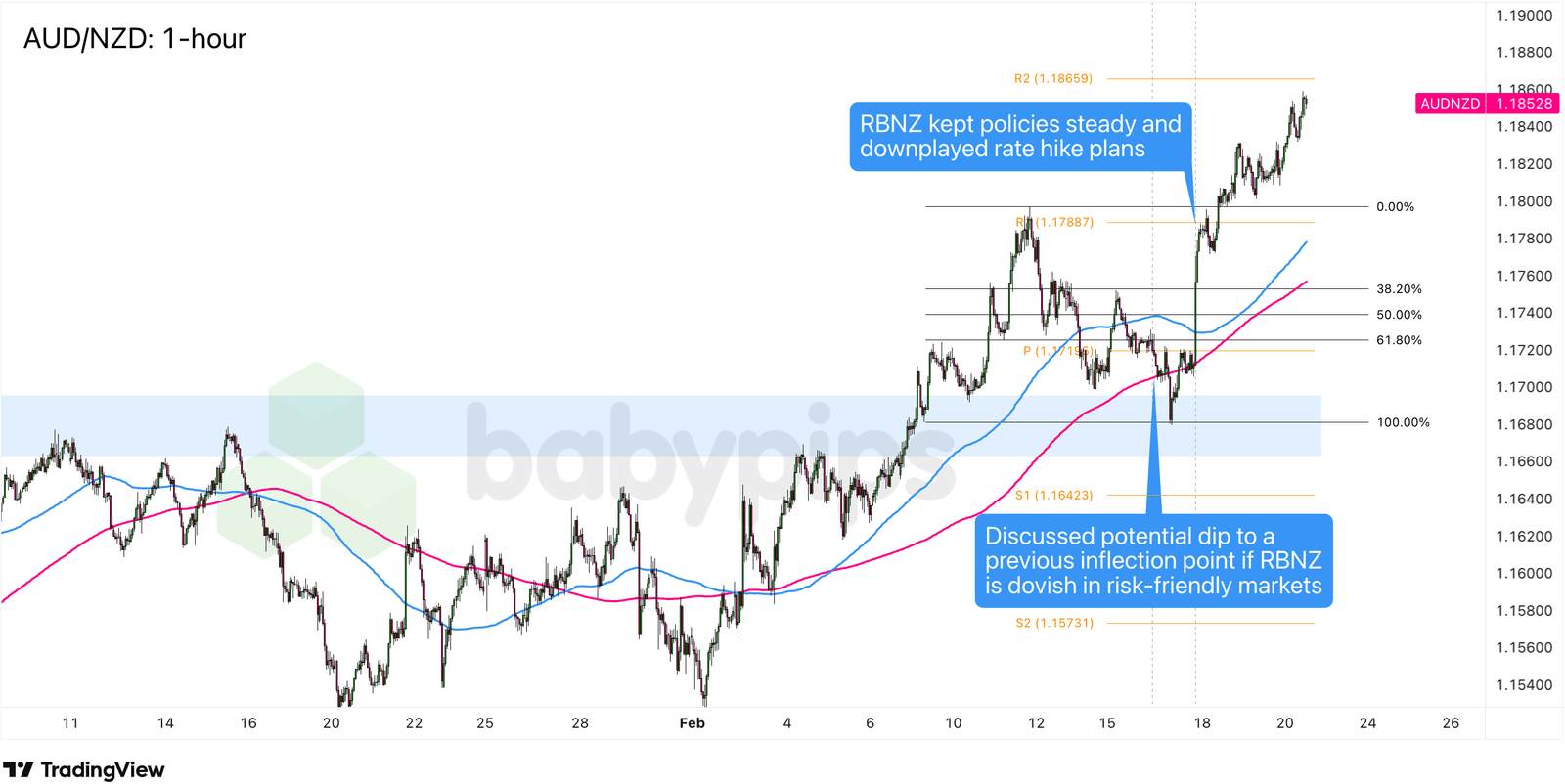
Our AUD/NZD watchlist idea focused on a possible bounce off an area of interest around the 1.1700 major psychological support in the event that the RBNZ decision turns out less hawkish than expected.
The pair had already been edging close to the resistance-turned-support around the original 50% Fibonacci retracement level leading up to the target event, as market anxiety was evident early the week prior to top-tier reports and geopolitical updates. Buyers started to defend the floor while Kiwi traders started positioning ahead of the RBNZ announcement, which then sparked a sharp selloff when the central bank’s forward guidance revealed they were in no rush to hike.
The RBNZ “dovish hold” contrasted sharply with the expected start of the RBA’s tightening cycle and openness to additional rate hikes, which were later on supported by upbeat Australian jobs data. Combined with anti-USD sentiment (Supreme Court tariffs decision, weak U.S. advanced GDP, partial government shutdown and US-Iran tensions) that indirectly supported risk assets later in the week, this rendered the AUD/NZD setup eligible to move beyond the watchlist stage.
While some safe-haven flows on US-Iran geopolitical tensions weighed on risk-taking around the target event, forex market movements appeared mainly focused on interest rate differentials then. Along with the rebound in gold prices, strong Australian employment data bolstered hawkish RBA bets and allowed the Aussie to take advantage of stabilizing risk appetite after the target event.
AUD/NZD spent the remainder of the week trading above post-RBNZ levels as it busted through the swing high near R1 (1.1788) then carried on with its climb to the 1.1850 minor psychological resistance by Friday’s close.
Traders who jumped in a long position at the area of interest or on a break above the pivot point (1.1719) during the RBNZ announcement could have caught majority of the rally.
Promoted: Think you’ve mastered the Macro? Prove it.
The RBNZ’s “dovish hold” created a massive opportunity for those who saw the policy divergence coming. If you have the strategy but lack the capital to truly scale these moves, it may be time to look at Maven.
Whether you’re trading the next central bank surprise or hedging geopolitical risk, Maven offers scaling plans and a professional trading environment used by 220K prop firm traders worldwide.
Learn More About Maven Trading Today!
Disclosure: We may earn a commission from our partners if you sign up through our links, at no extra cost to you.
Not Eligible to Move Beyond Watchlist – NZD/JPY & Bullish NZD Setups
NZD/JPY: Bearish NZD Event Outcome + Risk-Off Scenario
NZD/JPY 1-hour Forex Chart Faster with TradingView
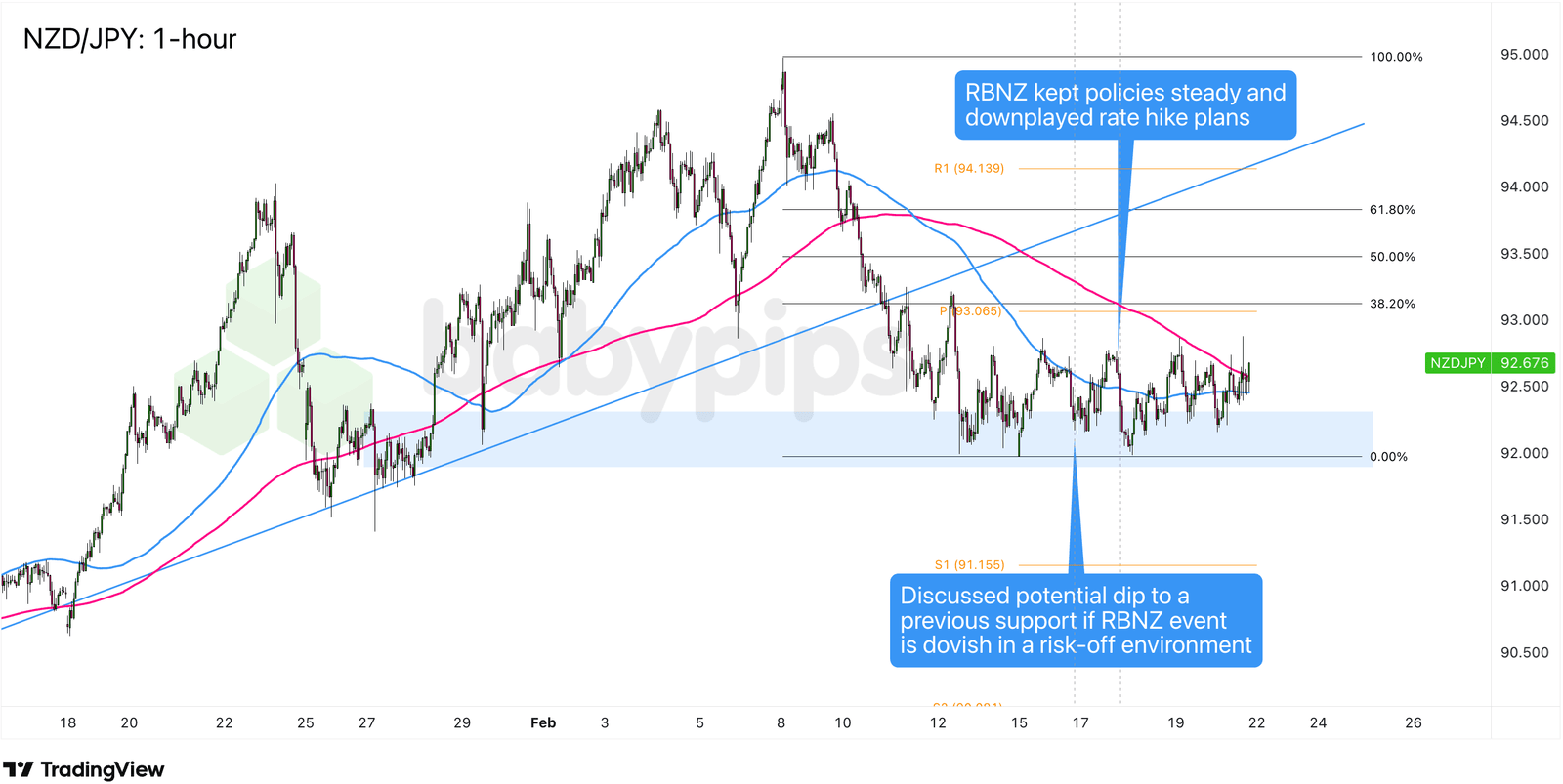
This bearish NZD/JPY setup eyed a possible shallow pullback or a breakdown in the event the RBNZ decision turns out more dovish than expected in a risk-off setting. The pair had previously broken below a longer-term ascending trend line to suggest that a downtrend may be in the cards.
Although some safe-haven flows had been in play during the first half of the week, the pair hesitated to extend its slump below the 92.00 major psychological support, which held as a solid floor throughout. As it turned out, weaker than expected Japanese GDP released on Monday dampened BOJ tightening expectations while the lack of verbal and actual yen-tervention midweek kept the currency’s gains in check, followed by downbeat CPI on Friday.
As a result, NZD/JPY simply moved sideways between the 92.00 to 92.50 levels for the remainder of the week while yen-specific price dynamics appeared to outweigh broader market sentiment shifts.
GBP/NZD: Bullish NZD Event Outcome + Risk-On Scenario
GBP/NZD 1-hour Forex Chart Faster with TradingView
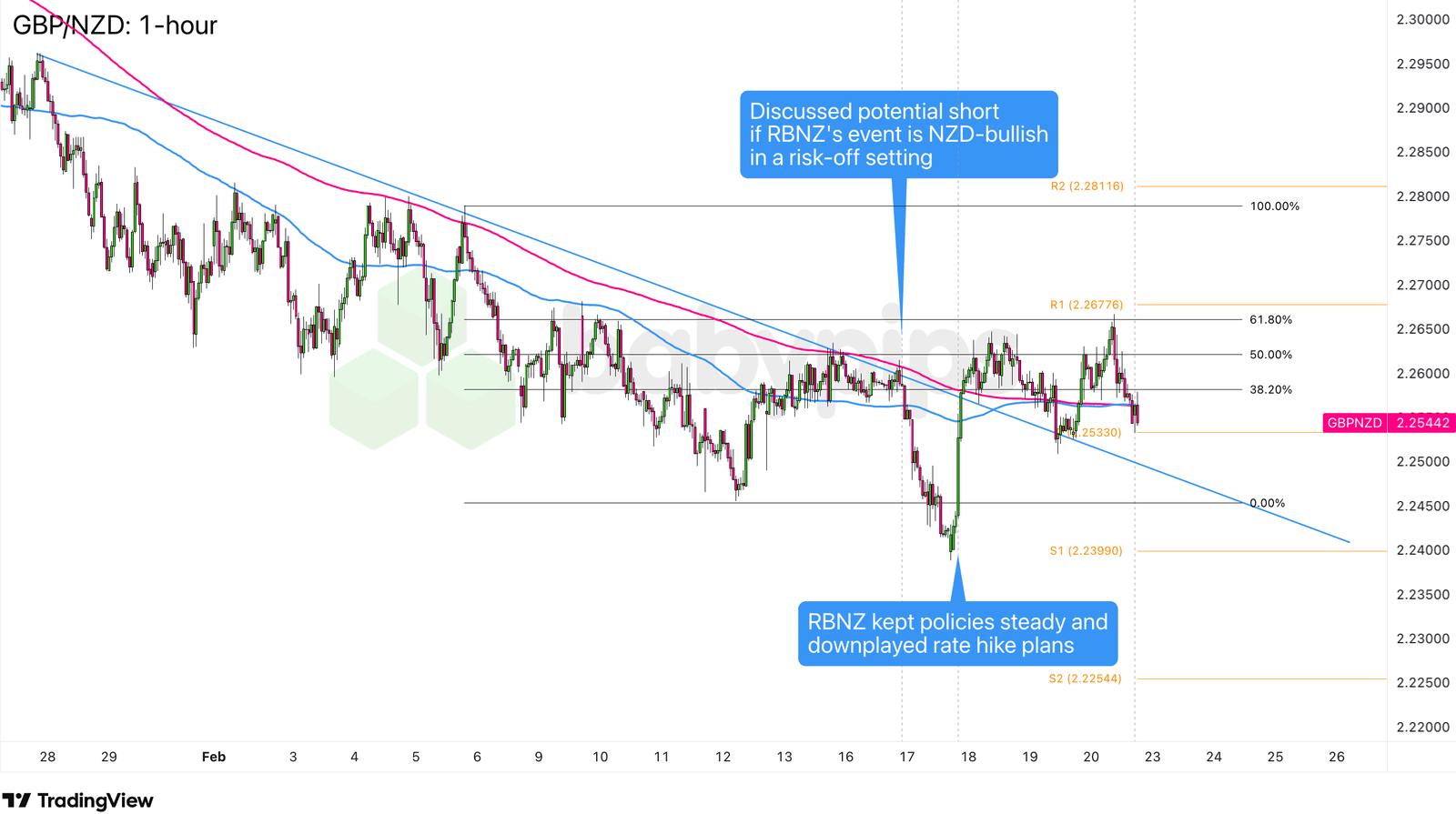
Our GBP/NZD watchlist discussed a potential short if the RBNZ event proved NZD-bullish in a risk-off setting, with 2.2600 as the key area of interest — aligning with the 200 SMA, the 50% Fibonacci retracement of February’s downswing, and the 2.2572 Pivot Point. Sustained trading below that level was expected to invite fresh selling pressure toward prior lows near 2.2470.
The RBNZ outcome was NZD-bearish, not NZD-bullish — the exact opposite of what this setup required. Rather than GBP/NZD facing downside pressure from a hawkish Kiwi, the pair surged sharply on the dovish RBNZ surprise. The pair extended gains in subsequent sessions, moving well above the 2.2600 resistance area that the setup anticipated as a ceiling.
The fundamental premise, that the RBNZ would surprise to the hawkish side, and the technical premise, that the 2.2600 level would hold as resistance, were clearly not met. With both conditions failing to materialize, this setup was not eligible to move beyond the watchlist stage.
NZD/CHF: Bullish NZD Event Outcome + Risk-Off Scenario
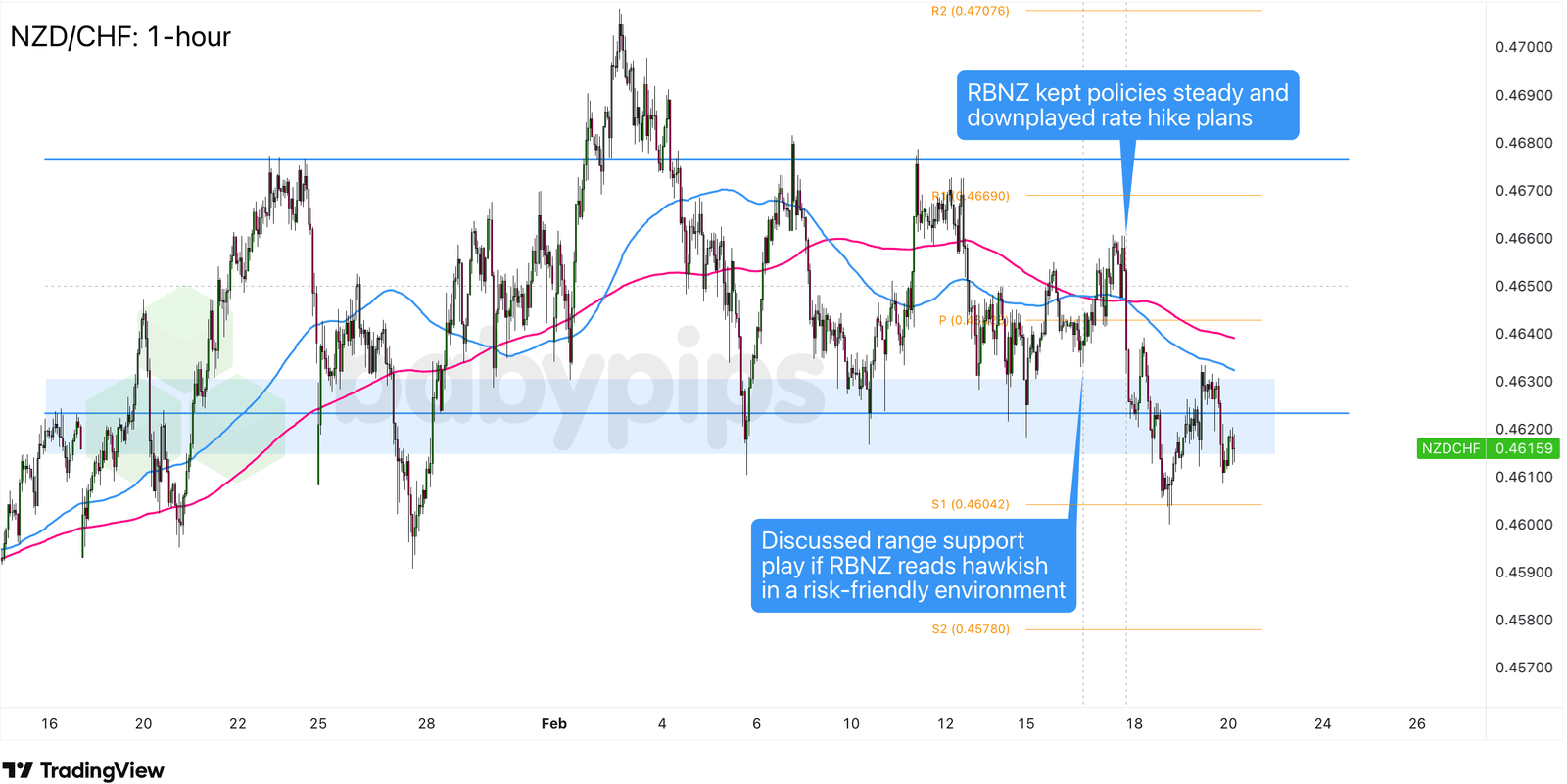
NZD/CHF 1-hour Forex Chart Faster with TradingView
Our watchlist for NZD/CHF bullish discussed a potential push toward the R1 Pivot Point (0.4670) and the 0.4680 range resistance in a risk-friendly environment if the RBNZ’s updated inflation forecasts pointed to near-term rate hike strength. NZD/CHF had been holding technical support at the 0.4620 area going into the event.
Instead, the RBNZ delivered a dovish surprise that was NZD-negative rather than NZD-positive. The fundamental premise — an RBNZ signaling earlier or more aggressive tightening — was not met. Governor Breman’s cautious commentary and a rate forecast track that pushed the first potential hike well into late 2026 or early 2027 invalidated the bullish NZD bias required for this setup. The concurrent risk-off environment from U.S.-Iran tensions provided no offsetting tailwind for a risk-sensitive NZD.
NZD/CHF broke below the 0.4620 support that had been holding and extended lower, confirming this scenario was not eligible to move beyond the watchlist stage.
Interested in fundamental analysis made for newbies and how to pair it up with technical analysis to find high-quality opportunities that may match your trading and risk management style? Check out our Premium membership for event trading guides, short-term strategies, weekly recaps and more!
BabyPips.com Annual Premium Members also get an exclusive 30% discount on the annual subscription for the first year on Tradezella–the top-rated journaling app! ($120 in savings)! Click here for more info!
The Verdict
The RBNZ decision came in line with expectations on the surface, as policymakers agreed to keep rates unchanged and pause from their easing cycle. However, their updated economic forecasts and press conference told the real story since officials seemed convinced that price pressures could slow down again and clarified that they aren’t looking to tightening policy anytime soon.
In particular, their updated OCR track pushed the first potential hike to late 2026 or early 2027, well short of the near-two-hikes-by-year-end that markets had priced in, leading Kiwi traders to unwind bullish positions.
At the same time, forex markets appeared to zone in on monetary policy divergences amid broader market uncertainty on geopolitical headlines and caution ahead of key U.S. developments. The start of the RBA’s tightening era allowed the Aussie to assert its dominance over other major currencies whose policy path remained unclear. Later on, resurfacing “Sell America” vibes stemming from tariffs drama and U.S. data misses undermined the hawkish Fed narrative, leading to a rebound in risk-taking.
Overall, we’d rate this week’s AUD/NZD watchlist setup as “highly likely” supportive of a net positive outcome. Not only did the pair respond as expected to widening central bank policy divergences, but it also reacted well to technical levels mentioned in the discussion and sustained its post-event reaction throughout the week.
Its price action during and after the RBNZ statement gave several opportunities to capitalize on the move on short-term pullbacks (1.1680 pre-event or 1.1780 post-event) and resistance breaks (pivot point, 1.1800 major psychological level, R1 and swing high).
Key Takeaways:
Policy Divergence Creates Durable, Multi-Session Themes
The RBA/RBNZ divergence — one hiking, one holding with caution — wasn’t a one-session story. AUD/NZD upside persisted across multiple days, supported by both the initial RBNZ shock and follow-up Australian labor market strength. When fundamental divergence is confirmed and widening, retracements often become better entry points rather than reasons to exit.
Pre-Event Positioning Amplifies Post-Event Moves
NZD’s Tuesday rally into the RBNZ decision, built on hawkish speculation and strong food price data, created the conditions for a more violent correction when the dovish surprise arrived. The greater the pre-event positioning divergence from the eventual outcome, the sharper the reversal. Monitoring positioning and pre-event price action can help calibrate expected move size.
Promoted: Why do some traders thrive on “Dovish Surprises” while others get liquidated?
The RBNZ’s February decision was a masterclass in how positioning can amplify reversals. If you want to move beyond just reading recaps and start anticipating these moves like a professional, you need to see how the world’s best “unknown” traders build their playbooks.
From discretionary macro players to systematic scalpers, “Unknown Market Wizards” breaks down the exact habits used to turn central bank volatility into consistent profit.
Learn more about Unknown Market Wizards at Amazon! (4.6 stars & 1,492 reviews)
Disclosure: We may earn a commission from our partners if you sign up through our links, at no extra cost to you.